

Reporting on banking news in the world
Provided by AGP
Inprentus awarded contract to make convex gratings for TASA CubeSat-based greenhouse gas observatory
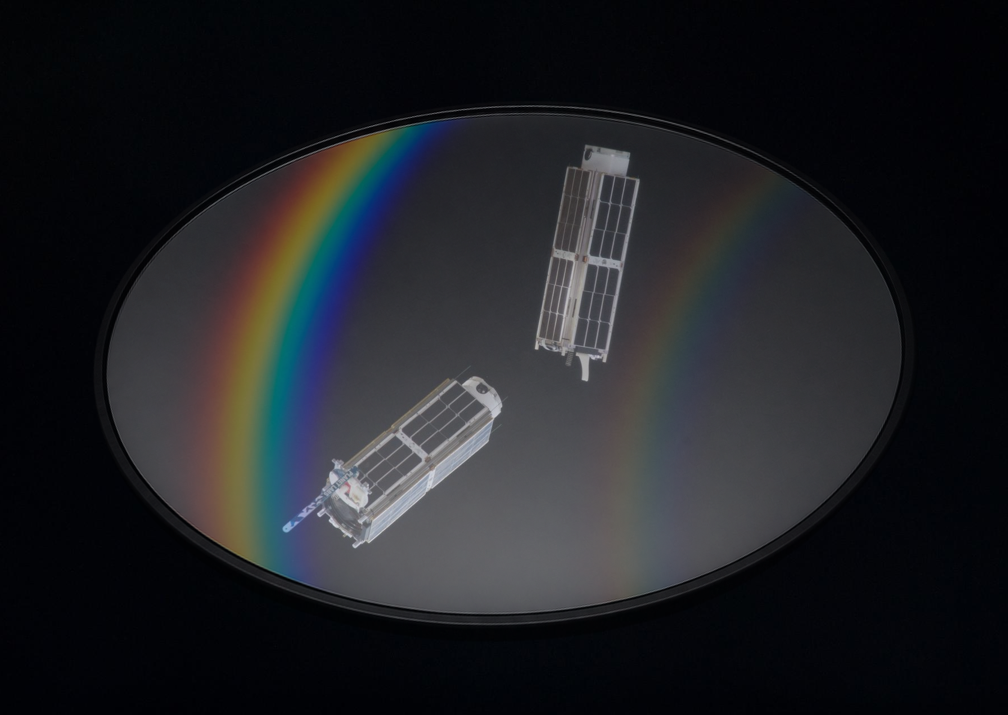
Inprentus will make curved diffraction gratings for a TASA CubeSat-based mission.
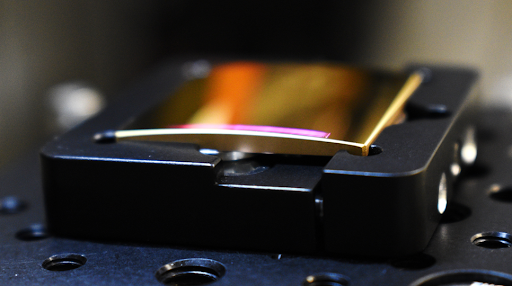
Grating grooves have been ruled into a convex surface during a manufacturing test for the TASA diffraction gratings.
Inprentus won a TASA contract to produce diffraction gratings, closely following a recent NASA award, highlighting Inprentus’ growing role in space instruments.
The contracts from NASA and TASA are votes of confidence in Inprentus’ ability to carry on Rowland’s legacy through the upgraded power of 21st Century mechanically ruled gratings.”
CHAMPAIGN, IL, UNITED STATES, May 4, 2026 /EINPresswire.com/ -- Inprentus, a global leader in advanced manufacturing of blazed diffraction gratings, has been awarded a contract by TASA (the Taiwan Space Agency) to produce ultra-high-precision convex spherical diffraction gratings for an orbital greenhouse gas (GHG) observatory. The award follows closely on the company’s recent contract with NASA for concave gratings for the ESIS-II solar mission, highlighting Inprentus’ growing role in space instrumentation.— Subha Kumar, Chief Operations Officer of Inprentus
Under the TASA contract, Inprentus will manufacture convex spherical gratings designed to detect the infrared signatures of carbon dioxide and methane. The components will support a proving mission aimed at demonstrating a compact spectrometer integrated with a telescope and detector into a CubeSat, a type of miniature satellite, similar in size to a 1-gallon water jug.
Inprentus will initially deliver two convex spherical gratings for ground-based testing and alignment of the prototype spectrometer. The planned orbital mission will map global greenhouse gas emissions by correlating spectroscopic data with geolocation, detecting subtle spectral variations indicative of 0.2% increases above ambient atmospheric concentrations.
The high spectral performance of Inprentus’ gratings is based on its proprietary digital ruler architecture combined with dynamic contact mode lithography technique, which allows for exceptional control in the shape and placement of individual grating grooves. This capability is particularly critical for curved optical surfaces, where precision directly impacts light throughput and spectral resolution. The successful extension of this technology to convex geometries marks a significant technical milestone and expands Inprentus’ addressable market in space-based optics.
“Inprentus’ unique curved grating technology took a step forward in sophistication with this project,” says Cody Jensen, Chief Technology Officer of Inprentus. “Our ability to apply precision ruling to convex surfaces means that we can make a wide range of compact space-based optics, enabling clients such as TASA and NASA to field more capabilities in smaller vehicles.”
TASA plans to include five convex gratings in their final satellite design, each tuned to the spectral signatures of specific greenhouse gases. This refined satellite is projected to be ready to fly by 2030. Once in orbit, the satellite will contribute to global climate monitoring efforts, including emissions tracking, atmospheric analysis, and observation of major environmental events, such as the Hunga Tonga submarine volcano of 2022.
Subha Kumar, Chief Operations Officer of Inprentus, adds a historical perspective to Inprentus’ achievement: “The Smithsonian's National Air and Space Museum displays a curved diffraction grating, made on one of Henry Rowland’s ruling engines, that flew on a 1946 solar spectrograph rocket flight. 80 years later, the contracts from NASA and TASA are votes of confidence in Inprentus’ ability to carry on Rowland’s legacy through the upgraded power of 21st Century mechanically ruled gratings.”
About Inprentus: Founded in 2012 by University of Illinois Professor Peter Abbamonte, Inprentus specializes in the manufacturing of blazed diffraction gratings using a novel, nano-scale mechanical ruling technique. The company provides state-of-the-art optical solutions for synchrotrons, free-electron lasers, semiconductor metrology, and space-based imaging systems worldwide.
Inprentus aims to apply 21st century mechanical ruling to solve critical current and future grating-centered challenges. We are committed to excellence, risk, and pushing boundaries by providing state-of-the-art blazed gratings that perform to unprecedented specifications and that enable novel applications. Outcomes include next-generation monochromators, spectrometers, laser systems, and analytical instrumentation in defense applications, as well as ground-breaking consumer experiences enabled by improvements in chip manufacturing and see-through AR waveguides. Inprentus is dedicated to facilitating next-level science and technology by continually enhancing our capabilities with cutting-edge developments, collaborations, and partnerships. For more information, visit Inprentus.com.
James Lee
Inprentus
+1 217-239-9862
email us here
Visit us on social media:
LinkedIn
Facebook
YouTube
X
Legal Disclaimer:
EIN Presswire provides this news content "as is" without warranty of any kind. We do not accept any responsibility or liability for the accuracy, content, images, videos, licenses, completeness, legality, or reliability of the information contained in this article. If you have any complaints or copyright issues related to this article, kindly contact the author above.
