

Monetary policy under multiple financing constraints
by Ander Perez-Orive, Yannick Timmer and Alejandro Van der Ghote[1]
The fact that monetary policy tightening has stronger effects than easing is a longstanding puzzle in monetary economics. This article studies monetary transmission in settings where firms face multiple financing constraints – a common and well-documented feature of corporate financing. Our theory shows that the multiplicity of financing constraints notably dampens the transmission of expansionary policy to firm borrowing and investment, while amplifying the transmission of policy tightening. This asymmetry arises because, when policy tightens, the most responsive constraint binds; whereas, when policy eases, the least responsive constraint limits the expansion of borrowing. We find strong empirical support for these predictions. Moreover, embedding the mechanism in a standard New Keynesian framework, we find that the decline in aggregate investment following contractionary monetary shocks is twice as large as the increase following equally sized expansionary shocks.
Asymmetry in monetary transmission
Few questions have captured the imagination of both research economists and monetary policymakers as that of the asymmetry of monetary policy transmission. There is by now a well-established body of research showing that tightening shocks tend to weigh on spending and employment more heavily than comparable easing shocks (Tenreyro and Thwaites, 2016; Angrist, Jordà and Kuersteiner, 2018; Barnichon, Matthes and Ziegenbein, 2022; Jordà, Singh and Taylor, 2024; Bobasu and Repele, 2025). Papers in this literature typically consider two mechanisms that might explain this asymmetry: (1) downward nominal rigidities in prices and wages (Debortoli et al., 2020) and (2) financial factors (Stein, 2014). Some evidence has been provided for the first mechanism, which is based on the idea that when monetary policy tightens, nominal wages do not adjust downward, leading to large declines in output (Debortoli et al., 2020). This article focuses on the second mechanism and its implications for capital expenditure and aggregate capital accumulation.
Multiple restrictions to firm borrowing
In a recent paper (Perez-Orive, Timmer and Van der Ghote, 2026), we use both a modelling framework and a micro-data approach to contribute to this area of research. The starting point of our analysis is that firms tend to face multiple financing constraints when borrowing from banks or in capital markets (Chart 1, panel a). For instance, they often face legally binding limits on the amount of outstanding debt as a fraction of different types of financial indicators. These indicators include measures of earnings or cash flows – such as earnings before interest, taxes, depreciation and amortisation (EBITDA) or free cash flow to the firm (FCFF) – and measures of asset values, like accounting values based on book values or mark-to-market values based on spot prices. Other types of legally binding limits that firms face include those related to the cost of servicing debt – for example, the interest coverage ratio (ICR) – or to the maturity of liabilities relative to the liquidity of assets, such as the liquidity ratio (LR). Lenders impose these and other types of limits mainly to ensure that both the business model and the balance sheet of the borrowing firm are sound and that it is possible to recover part of the loaned funds in the event of bankruptcy or default.[2]
Chart 1
Firms face multiple financing constraints
a) Financial indicators used to limit firm borrowing b) Firms with multiple tight borrowing limits

Sources: Compustat data and Refinitiv’s Loan Pricing Corporation DealScan database.
Notes: Panel a) shows the financial indicators typically used to limit firm borrowing (y-axis) and the fraction of firms that faces a financing constraint based on these indicators. Panel b) plots the distribution of the number of tight financing constraints across firms.
While the previous examples illustrate the range of financing constraints that firms may face, their economic relevance depends on whether these constraints are close to binding. In the data, we find that this is often the case: a significant share of firms face multiple tight financing constraints (Chart 1, panel b). A financing constraint is considered “tight” if the likelihood that its imposed limit will be breached in the short term exceeds a given threshold. By merging Compustat data with Refinitiv’s Loan Pricing Corporation DealScan database, we find that approximately 65% of non-financial corporate firms in the United States face two or more tight financing constraints. These firms tend to exhibit characteristics that differ from those of firms classified as financially distressed according to standard measures – notably distance to default (D2D)[3]. This suggests that the number of tight financing constraints can be an indicator of financial conditions not typically reflected in alternative measures.
Implications for monetary transmission
A simple model can illustrate how multiple tight financing constraints may influence the transmission of monetary policy. Consider an environment in which firms face two or more financing constraints and in which at least two of these constraints are binding. Following a monetary tightening, all constraints presumably tighten as well and, because at least some of them are binding, firms must reduce their borrowing and cut their capital expenditures. Moreover, because all constraints must be satisfied simultaneously, borrowing and investment must fall in line with the binding constraint that responds most strongly to the increase in the monetary policy rate – that is, the constraint that is most sensitive to the policy rate. By contrast, following a monetary easing, all constraints presumably relax, allowing firms to expand their borrowing and increase their capital expenditures. However, borrowing and investment can rise only in line with the binding constraint that responds least strongly to the reduction in the monetary policy rate – that is, the least sensitive binding financing constraint. This mechanism can therefore generate asymmetry in monetary transmission and, importantly, can do so even when individual financing constraints respond symmetrically to changes in the monetary policy rate.
The data broadly support the predictions of our model. Firms facing multiple tight financing constraints tend to adjust external financing more strongly following a monetary tightening than following a monetary easing of comparable size (Chart 2). By contrast, firms with either a single tight constraint or no tight constraints tend to respond roughly symmetrically. In addition, the larger the number of tight financing constraints, the stronger the asymmetry in the external financing response. The responses of capital expenditures by constraint status follow patterns similar to those observed for external financing.
Chart 2
Effect of monetary tightening and easing on external financing by constraint status

Source: Responses are estimated using a local projection specification based on Jordà (2005).
Note: The chart shows the response of external financing (i.e. the sum of debt and equity financing) to a monetary policy shock as a function of the number of binding financing constraints.
To quantitatively support our proposed mechanism – and, in particular, to quantitatively assess its effect on the aggregate investment response to monetary policy – we embed our simple model into a standard New Keynesian framework. This more realistic quantitative framework serves two additional purposes. First, it provides a setting in which multiple occasionally binding constraints naturally arise at the firm level. Second, it rationalises the possibility that, for many firms, these multiple constraints can bind simultaneously. In the calibrated model, we find that the contraction in aggregate investment following a monetary tightening is twice as large as the expansion following a monetary easing of comparable size (Chart 3, panel b). Moreover, a 0.5-point increase in the interest-rate elasticity of the most sensitive constraint strengthens the asymmetry of the aggregate investment response by approximately 20%. These effects are long-lasting and significantly influence the path of aggregate capital accumulation.
Chart 3
Impulse responses to monetary policy shock in a quantitative model
a) Investment of firms facing multiple binding financing constraints b) Aggregate investment
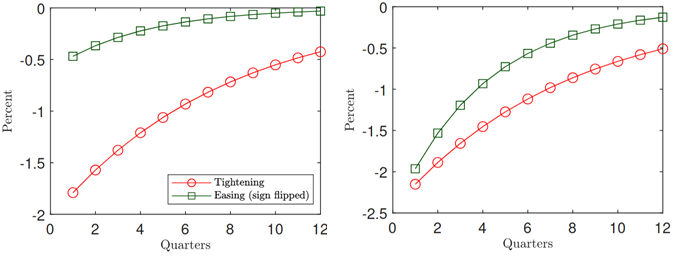
Source: Authors’ calculations.
Note: Impulse responses of investment of firms facing multiple binding financing constraints and of aggregate investment to monetary policy shock.
Conclusions
This article shows that multiple financing constraints represent an important channel through which monetary policy generates asymmetric effects on the real economy. In particular, our research demonstrates that the multiplicity of constraints generates strong asymmetries at the firm level in the response of external financing to monetary policy, and that it can account for a large part of the observed asymmetry in the aggregate investment response. All else being equal, these findings suggest it could be worthwhile adopting a more prudent stance during monetary tightening and a more forceful stance during monetary easing.
References
Angrist, J. D., Jordà, Ò. and Kuersteiner, G. M. (2018), “Semiparametric estimates of monetary policy effects: string theory revisited”, Journal of Business & Economic Statistics, Vol. 36, No 3, pp. 371-387.
Barnichon, R., Matthes, C. and Ziegenbein, A. (2022), “Are the effects of financial market disruptions big or small?” Review of Economics and Statistics, Vol. 104, No 3, pp. 557-570.
Bobasu, A. and Repele, A. (2025), “Effects of monetary policy on labour income: The role of the employer”, VoxEU, 30 April.
Debortoli, D., Forni, M., Gambetti, L., and Sala, L. (2020). “Asymmetric effects of monetary policy easing and tightening”, Working Paper Series.
Drechsel, T. (2023), “Earnings-based borrowing constraints and macroeconomic fluctuations”, American Economic Journal: Macroeconomics, Vol. 15, No 2, pp. 1-34.
Farre-Mensa, J. and Ljungqvist, A. (2016), “Do measures of financial constraints measure financial constraints?” The Review of Financial Studies, Vol. 29, No 2, pp. 271-308.
Jordà, Ò. (2005), “Estimation and inference of impulse responses by local projections” American economic review, Vol. 95, No 1, pp. 161-182.
Jordà, Ò., Singh, S. R. and Taylor, A. M. (2024), “The long-run effects of monetary policy”, Review of Economics and Statistics, pp. 1-49.
Lian, C. and Ma, Y. (2021), “Anatomy of corporate borrowing constraints”, The Quarterly Journal of Economics, Vol. 136, No 1, pp. 229-291.
Perez-Orive, A., Timmer, Y. and Van der Ghote, A. (2026), “Monetary policy under multiple financing constraints”, Working Paper Series, No 3217, ECB.
Stein, J. (2014). “Incorporating financial stability considerations into a monetary policy framework: a speech at the international research forum on monetary policy”, Board of Governors of the Federal Reserve System (US), No 796.
Tenreyro, S. and Thwaites, G. (2016), “Pushing on a string: US monetary policy is less powerful in recessions”, American Economic Journal: Macroeconomics, Vol. 8, No 4, pp. 43-74.
Legal Disclaimer:
EIN Presswire provides this news content "as is" without warranty of any kind. We do not accept any responsibility or liability for the accuracy, content, images, videos, licenses, completeness, legality, or reliability of the information contained in this article. If you have any complaints or copyright issues related to this article, kindly contact the author above.
